The history of speed on the water: from Crossbow to the F50
From Crossbow to windsurfers, kites, Sailrocket and foiling F50s: how speed on the water evolved over 50 years, and what data shows beyond top speed.
By Mario Iannotta · Updated
Read in: Italiano · Français · Español · Deutsch · Nederlands · Português

The outright sailing speed record went from 26.3 knots in 1972, set by the proa Crossbow, to 65.45 knots in 2012, set by Vestas Sailrocket 2. In between, windsurfers, a wingsail craft, kites and hydrofoils each held the title.
Measurement changed along the way too. Records were once timed on fixed courses; today you get detailed GPS data after almost any session, and the question riders ask is the same one: how fast can you actually go?
1972-1980: the Crossbow era
The first officially recognised speed sailing record dates back to 1972, when Tim Colman took his 56-foot proa Crossbow to 26.3 knots. That sounds modest next to today’s numbers, but at the time it changed what people thought a sailboat could do. Colman kept pushing and had reached 31.10 knots by the mid-1970s. His follow-up boat, Crossbow II, carried the record into the early 1980s and eventually touched 36 knots.
For the next fifty years the record moved the same way: each time the limit seemed to be found, someone arrived with a new way of reducing resistance.
When did windsurfers take the speed record?
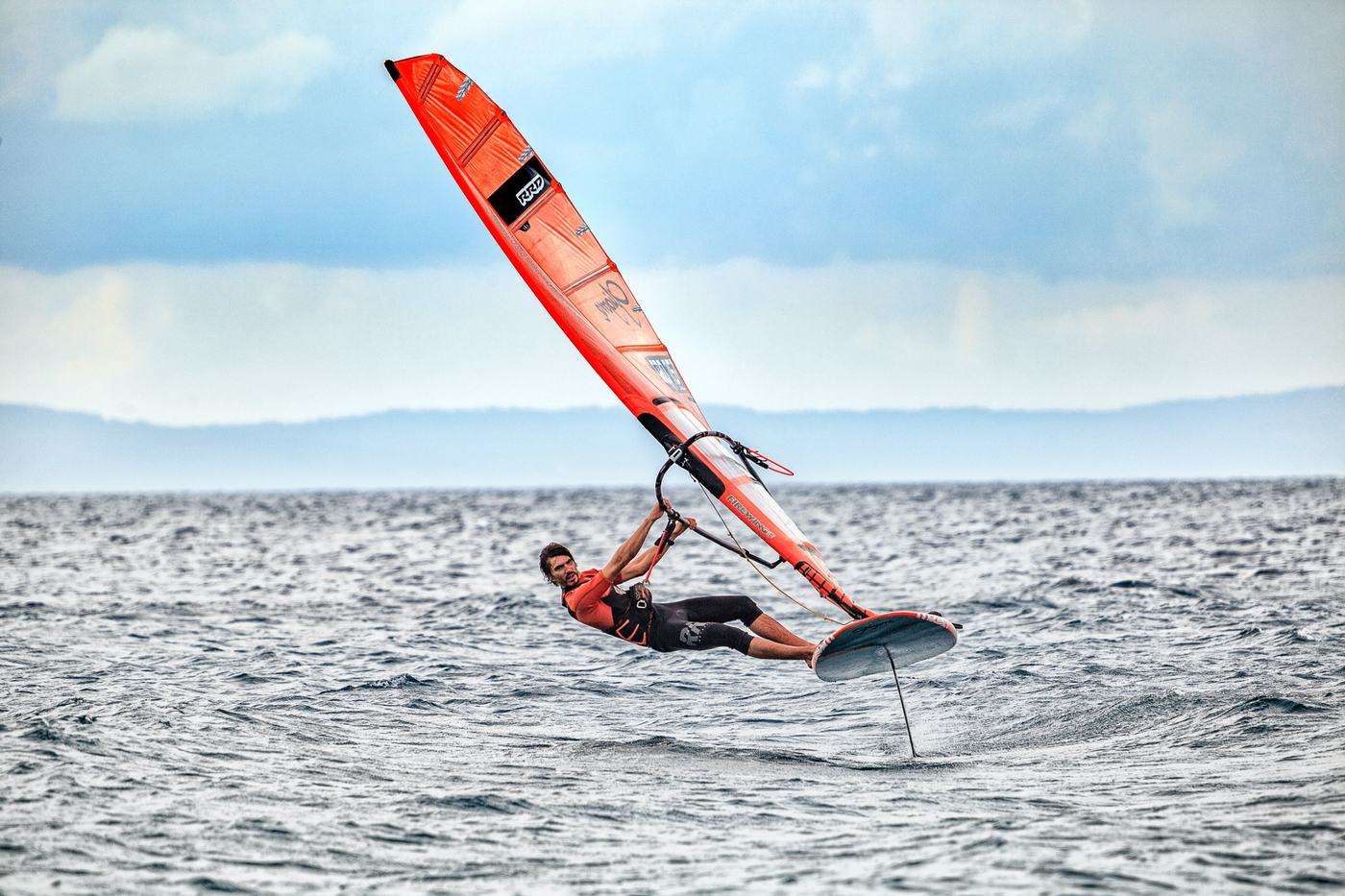
Windsurfers held the outright record from 1986 until 1993. As boards and rigs became faster and more specialised, individual riders started beating purpose-built boats.
In 1986, French windsurfer Pascal Maka pushed the outright record to 38.86 knots at Sotavento. Two years later Erik Beale became the first sailor to officially break 40 knots, averaging 40.48 knots over 500 metres at Saintes-Maries-de-la-Mer in France. The speed canal built there became one of the most important venues in speed sailing history.
The records kept falling. Maka reached 42.91 knots in 1990, and then Thierry Bielak pushed the mark through 43 and 44 knots to 45.34 knots in 1993.
Windsurfers today chase the same number, usually from a watch or phone: they track their windsurfing speed, compare runs and analyse whole sessions without a dedicated record course.
1993-2004: the wingsail interruption
In October 1993 the outright record left windsurfing. Australian sailors Simon McKeon and Tim Daddo took Yellow Pages Endeavour to 46.52 knots at Sandy Point, Australia.
Lindsay Cunningham designed the craft for speed alone, around a rigid wingsail and an unconventional layout, and its record stood for more than a decade. It also pointed to something that would matter more and more in high-performance sailing: the biggest gains often come from changing how the craft meets the water.
2004-2008: windsurfing comes back
Windsurfers caught up again. Finian Maynard broke the outright record with 46.82 knots in 2004 and improved it to 48.70 knots in 2005. In March 2008, Antoine Albeau raised it to 49.09 knots.
By then 50 knots felt inevitable, but a kite got there first.
2008-2010: when did kites break 50 knots?
Kites broke 50 knots in 2008, at Lüderitz in Namibia. Speed sailing’s centre of gravity had shifted there, to a purpose-built speed channel where strong winds and very flat water made the next jump possible.
In October 2008, American kitesurfer Rob Douglas reached 49.84 knots. Then Sébastien Cattelan went faster, at 50.26 knots: for the first time, a sailing craft had officially averaged more than 50 knots over 500 metres. Alexandre Caizergues pushed the record to 50.57 knots soon after, and by 2010 Rob Douglas had reached 55.65 knots.
Lüderitz is still one of the defining locations in speed sailing. It keeps attracting some of the world’s fastest windsurfers, who now analyse their runs with GPS tracking that once would have needed specialised timing infrastructure.
2009-2012: hydrofoils change the question
While windsurfers and kites fought for records close to the surface, another idea was developing: what if you lifted most of the hull out of the water?
In 2009 Hydroptère, Alain Thébault’s experimental foiling trimaran, set a 500-metre record of 51.36 knots. Hydrofoiling wasn’t new, but at this level of performance its potential was hard to ignore. The boat gained its speed by lifting itself above the water to cut drag.
Three years later came one of the biggest jumps in speed sailing history. In November 2012, Paul Larsen sailed Vestas Sailrocket 2 at 65.45 knots over 500 metres in Walvis Bay, Namibia. That’s roughly 121 km/h, and more than a decade later the record still stands.
From Crossbow’s 26.30 knots in 1972 to Sailrocket’s 65.45 knots in 2012, the outright sailing speed record grew by almost 150%.
2024-2026: records keep falling
More than thirty years after windsurfers first held the outright record, the discipline is still pushing its own limits. On December 1, 2024, Antoine Albeau set a new windsurfing world record of 53.49 knots (99.06 km/h) over 500 metres at Lüderitz. He had first taken the outright sailing record in 2008, so sixteen years on he was still finding speed.
Riders at Lüderitz now chase gains measured in fractions of a knot, which can come from equipment, angle, conditions, technique or one run sailed better than the last.
At events such as DÉFI, Waterspeed users chase speed on a smaller scale: they record sessions, compare numbers and ask each other how fast they went (see riders’ top speeds at DÉFI). A long event like that also rewards pacing and holding speed over distance, which is why preparing for a long-distance race means looking past one peak number.
How fast is an F50 in racing?
An F50 races at more than 100 km/h, and SailGP’s F50 racing speed record stands at about 103.9 km/h, set during the 2025 season.
That is a different measure from the outright sailing speed record. Vestas Sailrocket 2 was built to go as fast as possible over a straight 500-metre course. An F50 has to accelerate, manoeuvre, sail different angles, race other boats and keep turning speed into progress around a course.
During a SailGP session in Portsmouth, NorthStar reached 96.6 km/h while recording the whole session with Waterspeed. Its averages over longer distances were:
- 88.3 km/h over its fastest 500 metres
- 86.5 km/h over 1 kilometre
- 79.4 km/h over 5 kilometres
- 78.0 km/h over 10 kilometres
The drop from 96.6 km/h peak to 78.0 km/h over 10 kilometres shows how much of a fast session is spent below the top number. The full NorthStar performance analysis breaks the session down further.
What is the pattern behind fifty years of speed records?
Most of the big jumps came from reducing drag, by getting more of the craft out of the water, more than from adding power. Windsurfers, kites and finally full foiling each cut the wetted area further. For anyone training today, that is why session data like time on foil is worth reading alongside top speed.
Measurement improved alongside the boats. Early records were timed with stopwatches over a fixed course. Today a Waterspeed session captures GPS speed in real time, with no sanctioning body or 500-metre channel involved, so anyone with a tracker can ask the record setters’ question about their own session.
Where do you fit in?
You’re probably not chasing the 65.45-knot outright record, but every time you hit Start Session you’re measuring the same thing.
Open your last session in Waterspeed and check your top speed. Then look at how long you held it, where it happened and what changed before and after your fastest run. Those details tell you more about what to change next time than the peak itself.